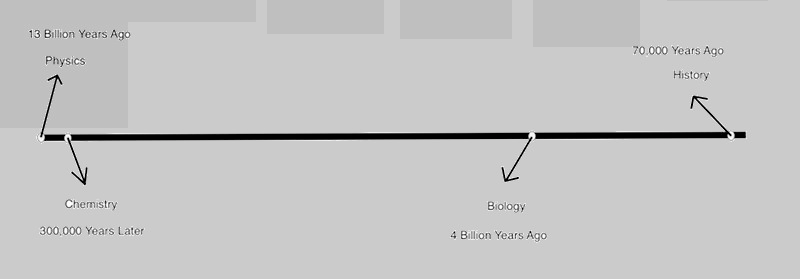
In the first section of the Coursea course Dr Harami started with the timeline of everything. About 13 billion years ago was the Big Bang where matter came into being. Physics examines how matter, energy, time, and space interact. About 300,000 years after that matter and energy started combining to form atoms which then formed complex molecules and this becomes Chemistry. About 4 billion years ago even more complex structures started to form call organisms “living” which is Biology. And then about 70,000 years ago was what he terms the Cognitive Revolution is where History begins and is about the human cultures that formed about that time.
But he goes on to say that Humans much like us now first appeared about 2.5 million years ago in East Africa. For most of this time we were an unimportant species. Genus then Species Homo (Genus) Sapiens (species). Family like cats (lions, tigers, panthers, house cat). Homo Sapiens has a family. Family of Great apes.
Neanderthals evolved in cold climates. Homo Solensis evolved in Java. Homo Floresiensis were dwarves. Homo Erectus were large and most successful 1.5 million to about 50,000 years ago. Homo Denisova existed in central Asia. Our own species appeared in East Africa about 200 to 300 thousand years ago. Around 100,000 years ago there were at least 6 different Homo species living on planet earth at the same time.
Right from the start Dr Harami is introducing subjects that a lot of people do not accept as comparing us to other animals just is not possible to even consider. I had more problems wrapping my mind around the start of History at the 70,000 scale as leaves out so many things. Since there are no written records from this time, one can argue that this is just an arbitray date. For Dr Harami Cognitive is the ability to communicate, remember, learn, and think. And this is around the time that Homo Sapiens started showing some unique capabilites. Do not completely buy into his theories on this point not ruling completely out Cognitive abilites in other human species.