Migration
Our species evolved in East Afica between 300,000 and 200,000 years ago. Most experts do agree that by 150,000 years ago East Africa was populated by homo sapiens that look just like us. Around 70,000 years ago homo sapiens left East Africa and quickly spread though the EuroAsian continents. When Homo Sapiens arrived in the Middle east it was already populated by other human species like Neanderthals and Homo Erectus.
Homo Sapiens vs. Homo Elsewhere: A Race Against Time and Genes?
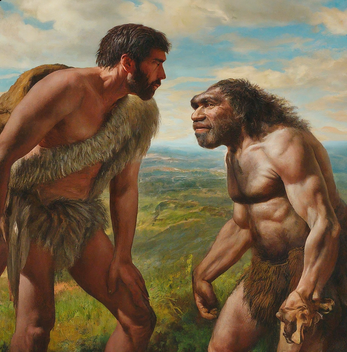
In his captivating lecture, Dr. Yuval Noah Harari delves into the fascinating migration of Homo sapiens out of Africa and their encounters with other hominin species like Neanderthals and Denisovans. But what were these meetings like, and why did these “other humans” disappear shortly after? Let’s explore the theories and ponder the intriguing “what ifs.”
A Clash of Titans: Imagine our early ancestors, venturing into new lands, only to find other intelligent beings. Did they trade tools and knowledge? Compete for resources? The evidence is scarce, but DNA whispers of interbreeding, suggesting at least some interaction.
The Vanishing Act: However, the bigger mystery is their disappearance. Theories abound:
Disease: Did our immune systems, exposed to new pathogens, unwittingly wipe them out?
Violence: Did competition for resources or territorial clashes lead to conflict?
Assimilation: Did interbreeding dilute their populations into our own?
The truth likely lies in a complex interplay of these factors, painting a picture of a dynamic, and possibly tragic, encounter.
Religion and Politics in a Multi-Homo World:
Imagine a world where multiple hominin species co-exist. Religion, often shaped by shared experiences and environment, could have taken vastly different forms. Would there be inter-species deities or shared rituals? Politics, too, would be fascinating. Would alliances form based on species or shared goals? Could there have been discrimination or prejudice based on physical differences?
A Hypothetical Future:
While purely hypothetical, contemplating these “what ifs” expands our understanding of ourselves. It reminds us that our history could have unfolded differently, and that our current dominance is not preordained. It also encourages empathy, urging us to consider how we interact with other beings, human or otherwise.
The Takeaway:
Dr. Harari’s lecture isn’t just about the past; it’s a mirror reflecting on our present. By understanding our complex history, we can better appreciate our diversity and strive for a future where “Homo elsewhere” might not just be a relic of the past, but a potential neighbor.
Remember, this is just a starting point. The lecture is rich with details and nuances, so delve deeper and explore the fascinating world of our early ancestors and their encounters with other hominins!