Anthropology is a subject that has always interested me from an early age. Remember being fascinated by a book written by Desmond Morris titled “The Naked App” which was slanted to a more general audience rather than a scientific tome. I then became infatuated by the aquatic ape theory, championed by Elaine Morgan for years that made its way into the scientific mainstream, contends that some of our ancestors dwelled primarily in water. Morgan also cited the elephant, which she once claimed had a hairless ancestor to similar ridicule though that theory has since been accepted. “Every animal that has become naked has been conditioned by water,” she said. Carole Cadwalladr of the Guardian noted, “Morgan has been dismissed as a nutcase for years, but both David Attenborough and Daniel Dennett have recently come around.” It is interesting that most large populations are either on seashores, lakes, or rivers.
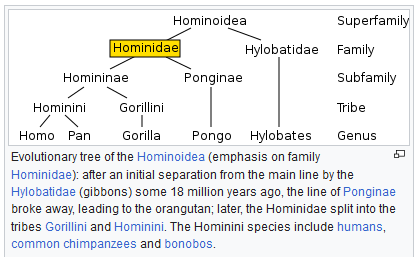
The next influential person in my jouney has been Jared Diamond being introduced to him while visiting my daughter and reading “Guns, Germs, and Steel: The Fates of Human Societies”. This was in a more advanced stage in human development preferring his earlier book “The Third Chimpanzee”. Below is a chart showing the Hominidae tree:
The next person that has piqued my interest is the fictional writer Jean M Auel who wrote the Earth’s Children books. The most interesting for me was “The Valley of Horses” which did great explaining basic survival skills being alone in the wilderness. Her first book in the series brought living with Neatherthals and some of what she wrote about is slowly being recognized as possible in today’s research.
The most influenced in this area came when I took a coursea.org course “A Brief History of Humankind” by Dr. Yuval Noah Harari which made me aware of so many things that I had never known or heard. “Sapiens: A Brief History of Humankind” is a book written by Yuval Noah Harari and published in 2014. It is a popular and well-received book that provides a comprehensive overview of the history of the human species, from the emergence of Homo sapiens in Africa to the present day.
The book covers a wide range of topics, including the development of human society, the evolution of language and culture, the rise of civilizations, the development of science and technology, and the current challenges facing humanity.
Throughout the book, Harari uses a narrative style to make complex topics accessible and engaging to a general audience and draws on the latest research in fields such as archaeology, biology, history, and psychology to provide a unique perspective on human history.
Overall, “Sapiens” is highly regarded for its comprehensive and accessible approach to the history of humanity and is considered a must-read for anyone interested in understanding the past and the future of our species.