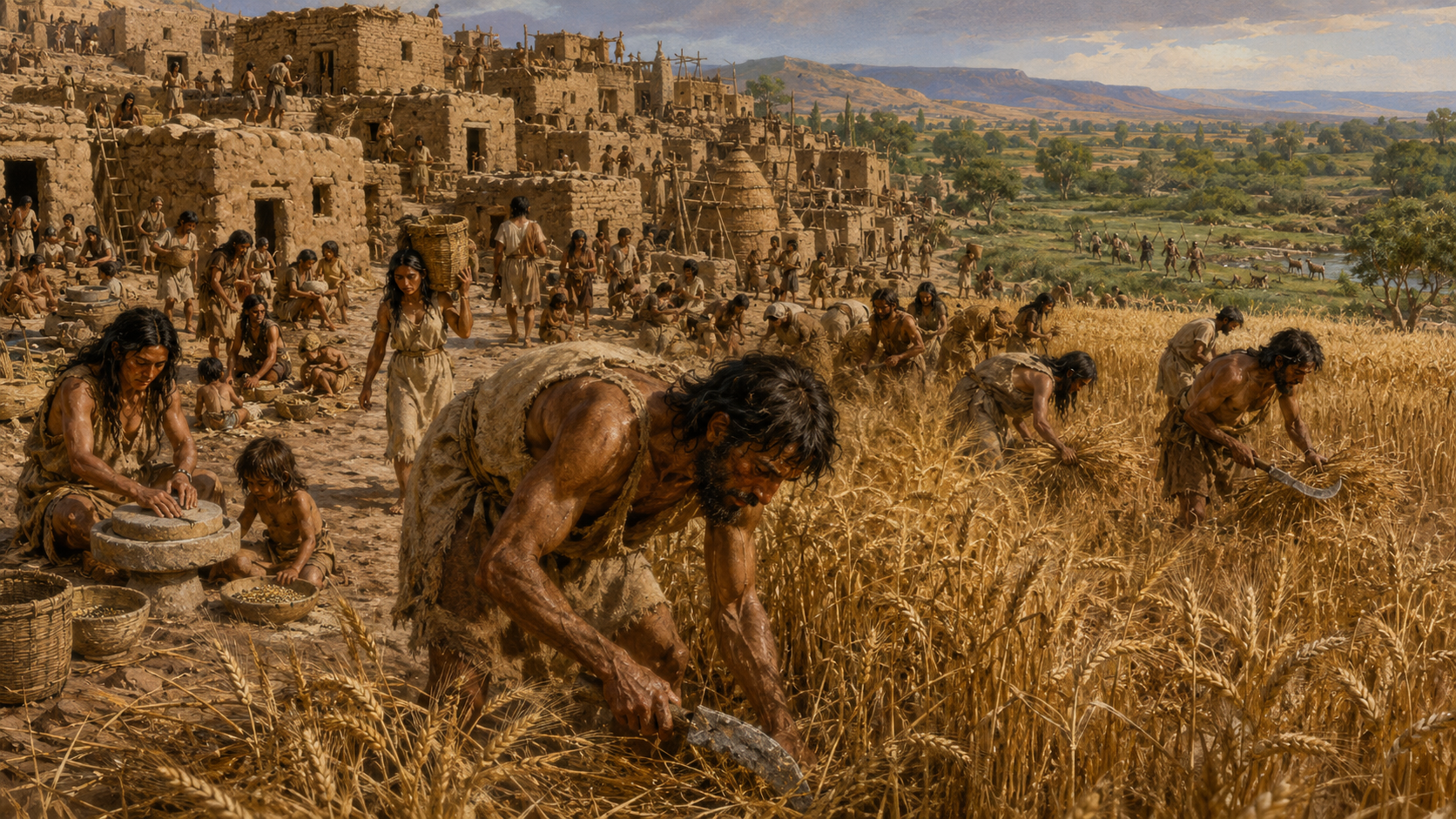
The Wheat Bargain: Why Humans Chose a Harder Life
In the previous segment we saw that plants domesticated Homo sapiens, not the other way around. The new cultural way of life was harder and more miserable than foraging. So why did wheat convince us to trade a good life for a worse one? What did it offer in return?
Wheat did NOT offer a better life as individuals
- No better diet. Humans are omnivorous apes who thrive on a wide variety of foods. Pre-agricultural diets were diverse. A grain-based diet is poor in minerals and vitamins, hard to digest, and bad for teeth and gums. Our bodies never evolved for cereals.
- No economic security. Peasants lived off 1-3 crops: rice in China, barley/wheat in the Middle East, maize in Central America. One drought, flood or parasite could wipe out the crop and kill millions. Hunter-gatherers ate many different foods, so a scarcity of one could be offset by another.
- No protection from violence. Early farmers were probably more violent than foragers. A foraging band losing a conflict could move on. A farming village could not retreat without giving up fields, houses and granaries — a death sentence by starvation. So they had to fight to the bitter end.
Anthropological studies suggest in simple agricultural societies ~15% of all deaths and ~25% of male deaths were from human violence. 8,000 years ago a man had a 25% chance of being killed by another man.
We only see agriculture as progress because we judge it from the perspective of 21st century affluence, which is built on agriculture. A more honest viewpoint is a 3-year-old peasant girl dying of malnutrition in 1st century China. She did not think her suffering was worthwhile for future air-conditioned houses.
So what did wheat offer?
Not to individuals, but to Homo sapiens as a species.
Cultivating wheat produced much more food per unit of territory than foraging. That extra food allowed the numbers of sapiens to grow exponentially.
Example: Jericho oasis.
- ~13,000 years ago, with wild plants and hunting: ~1 band of ~100 healthy, satiated people.
- ~8,000 BC, with wheat fields: a village of ~1,000 people.
Those Jericho villagers were hungrier, less healthy and probably less happy than their hunter-gatherer ancestors. But there were many more of them.
Evolution measures success not by happiness or suffering, but by number of copies of DNA in existence. 1,000 copies is always better than 100 copies. That is the essence of the agricultural revolution: the ability to keep many more people alive under worse conditions.
Why did people accept it?
People never consciously agreed to it. It was an accumulation of many small steps, impossible to pinpoint the decisive transition.
By ~8,500 BC the Middle East was peppered with permanent villages like Jericho. As people relied more on domesticated species, they spent more time in the fields and less time hunting/foraging. They had to stay close to the fields.
Population began to grow for two reasons:
- Agriculture provided more food, so more people could be fed.
- Settling in permanent villages changed reproduction. Hunter-gatherer women waited 3-4 years between births, because carrying a non-walking child while nomadic was too hard. Peasant women could have a baby every year and were encouraged to, because extra hands were needed in the fields.
The problem: the new children had mouths as well as hands. They ate all the extra food agriculture produced.
Infectious diseases also exploded:
- Diseases jumped from domesticated animals to humans.
- Villages were crowded and unsanitary, near garbage and toilets.
- Diet worsened. Hunter-gatherer babies nursed for 2-3 years on mother’s milk. Peasant babies were weaned early onto porridge and gruel, terrible for immune development.
Result: at least a third of babies born in agricultural societies died before adulthood. Adults suffered more disease too.
Still, births outpaced deaths. More humans lived in villages and towns, even though they were less healthy and had a harder life.
Each generation lived like its parents, just a little more efficiently. Paradoxically, each improvement meant to make life easier — like bringing water to the wheat — added up to a very heavy burden.
Next segment: Why did people make this fateful miscalculation?