Notes and reflections on Yuval Noah Harari’s course lecture, “Building Pyramids.” The explanations below summarize the arguments presented in the lecture.
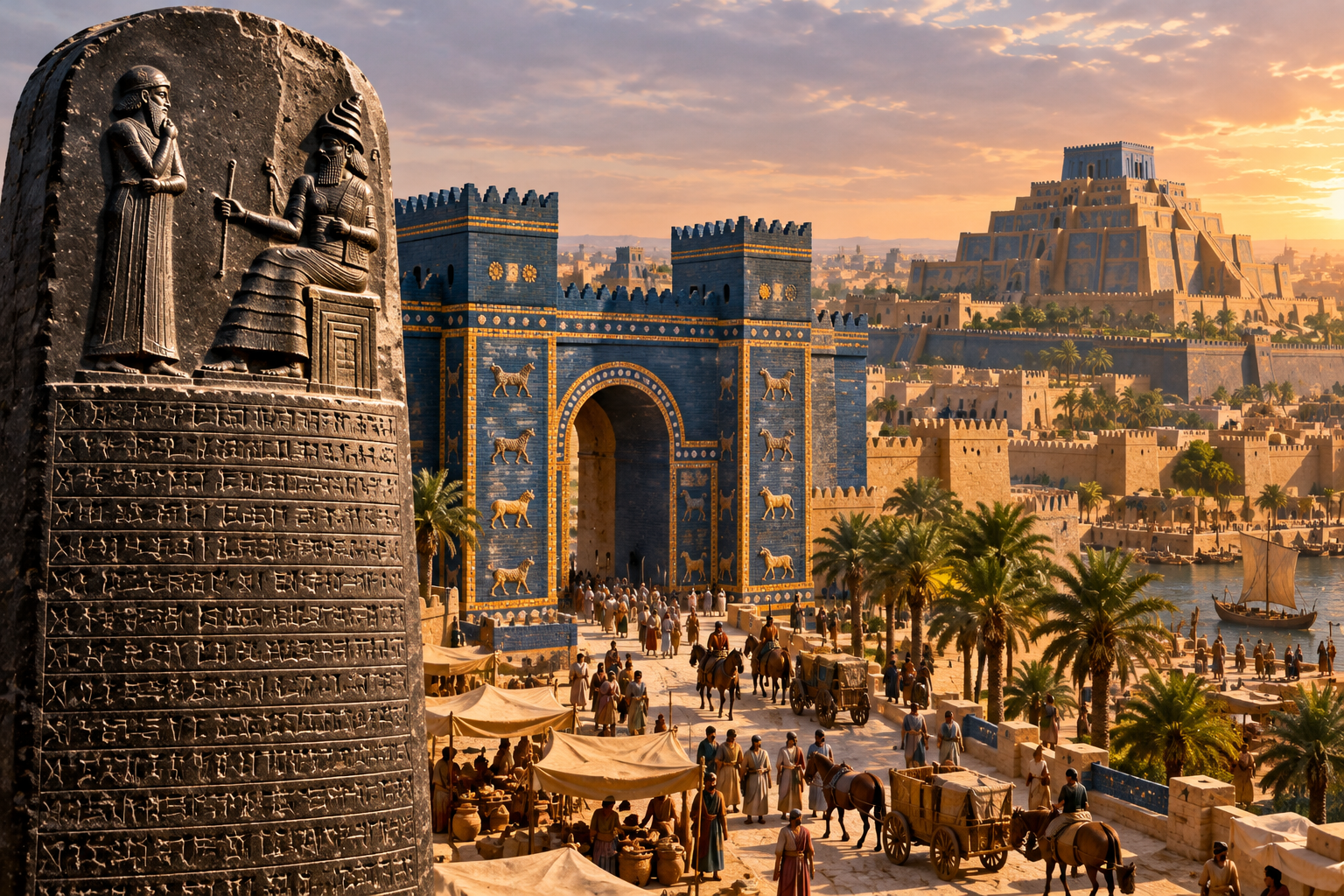
Building Pyramids: The Stories That Hold Societies Together
The agricultural revolution did more than increase the amount of food humans could produce. It made possible a new kind of society.
Foragers had usually lived in small bands, sometimes connected to larger tribes. Farmers increasingly lived in villages and towns containing hundreds or thousands of people. Eventually humans created cities, kingdoms, and empires in which millions of strangers had to cooperate every day.
Harari’s central question in this lecture is simple: how did people who did not know one another manage to live and work together on such a scale?
More Food Was Necessary, but Not Enough
Agriculture could support far more people on a given area of land than hunting and gathering. That made large settlements physically possible.
But Harari argues that food alone cannot create a stable society.
Ten thousand people might have enough grain to survive, yet they still have to agree about who owns the land, who gets the water, how food is distributed, how disputes are settled, and what happens during war or drought.
A full granary does not automatically produce cooperation.
Harari points to wars and revolutions to emphasize this distinction. Political conflict often erupts not because there is literally no food, but because people disagree about power, identity, territory, religion, justice, or the rules under which society should operate.
The problem is therefore not only how to feed large populations. It is how to organize them.
Humans Were Not Built for Millions of Strangers
For most of human evolution, Homo sapiens lived in small groups. People knew the individuals around them and could rely on family relationships, friendship, reputation, and direct personal trust.
Cities and empires created a different problem.
Natural selection had not had enough time, Harari argues, to give humans instincts for cooperating automatically with millions of strangers. A person living in an empire could never personally know more than a tiny fraction of the people whose actions affected daily life.
To make large societies possible, humans needed something beyond personal acquaintance.
Harari says they relied on one of the abilities that had already helped smaller human groups cooperate: shared stories.
From Tribal Stories to Imagined Orders
Earlier human communities had stories about ancestors, spirits, gods, and tribal symbols. These stories could unite hundreds or perhaps thousands of people.
Agricultural societies used the same basic human ability on a much larger scale.
People developed shared beliefs about kings, laws, gods, nations, social classes, money, rights, and justice. Millions of people who had never met could nevertheless act according to the same rules because they believed in the same social order.
Harari calls this an imagined order.
The word imagined does not mean that the order is unimportant or that it is a conspiracy. An imagined order can be extremely powerful. It can determine who owns land, who commands armies, who pays taxes, who receives privileges, and which laws people are expected to obey.
Its power comes from the fact that large numbers of people believe in it together.
From Jericho to Empires
Harari describes how rapidly the scale of human organization increased after the agricultural revolution.
Around 8500 BC, even the largest settlements were still relatively small by later standards. Several thousand years later, cities and kingdoms could rule tens or hundreds of thousands of people. By the first millennium BC, large empires governed millions.
These societies could not be held together by personal relationships.
They depended on common beliefs about how society should be organized.
To illustrate this, Harari compares two famous documents separated by roughly 3,500 years: the Code of Hammurabi and the American Declaration of Independence.
Both claimed to describe a just social order.
Yet they described justice in radically different ways.
Hammurabi’s Hierarchy
Hammurabi ruled Babylon in the second millennium BC. His famous code presented the king as a just ruler appointed by the gods and offered hundreds of examples of how justice should work.
One of the most important principles behind the code was hierarchy.
People were divided into different social classes, and men and women within those classes did not have the same legal value. The punishment for injuring or killing someone depended partly on the status of the victim.
To modern readers, many of these rules appear deeply unjust. But Harari stresses that the Babylonians did not necessarily see them that way.
Within their imagined order, hierarchy itself was part of justice.
If everyone accepted his or her place in that hierarchy, the society could function. People could produce food, settle disputes, defend the kingdom, collect taxes, and organize large projects.
The system worked because enough people accepted the story that supported it.
A Very Different Story in 1776
Harari then jumps forward to the American Declaration of Independence.
The Declaration also claims to express universal principles of justice, but its best-known principle is almost the opposite of Hammurabi’s hierarchy:
all men are created equal and possess rights to life, liberty, and the pursuit of happiness.
The Babylonians organized society around inequality and hierarchy. The American political tradition proclaimed equality and individual rights.
Yet both systems presented their principles as something deeper than mere preference.
Each described its own social order as grounded in universal truth.
This creates the dilemma Harari wants us to notice.
If one society says justice requires hierarchy and another says justice requires equality, both cannot simply be descriptions of the same objective social structure.
Justice as an Imagined Reality
Harari’s argument is that concepts such as hierarchy, equality, rights, and liberty belong to the shared stories humans create rather than to the physical world in the same way that mountains, genes, or gravity do.
He uses the Declaration of Independence as a deliberately provocative example.
The Declaration says people are created equal and endowed by their Creator with rights. Harari contrasts that language with the descriptive language of biology. Biology describes human beings as the products of evolution, with genetic and environmental differences between individuals.
From that perspective, biology can describe organs, abilities, traits, reproduction, pleasure, pain, and survival. It does not by itself establish political rights or moral equality.
This does not mean that equality or human rights are useless ideas. Harari’s point is that they are social and moral principles rather than biological facts.
Their importance comes from the fact that people believe in them and build institutions around them.
Why Believe a Story?
A defender of equality might answer that even if equality is not a biological description, believing that people should be treated as equals helps create a stable and prosperous society.
Harari says that answer captures exactly what he means by an imagined order.
People do not have to believe a social rule because it can be discovered under a microscope. They may believe it because a shared commitment to that rule allows millions of strangers to cooperate.
The same logic, however, could also be used by someone defending a very different social order.
A supporter of Hammurabi might have argued that hierarchy was necessary for stability and prosperity.
That is what makes imagined orders so powerful—and so difficult to evaluate merely by asking whether they are “natural.”
Not a Conspiracy, but a Human Tool
Harari is careful to distinguish imagined orders from conspiracies or meaningless illusions.
Large-scale human cooperation depends on shared beliefs.
Money works because people collectively accept its value. Governments function because people recognize offices, laws, borders, and institutions. Legal systems work because judges, police, officials, and citizens accept common rules.
These things are not physical facts in the same way that a river or a tree is physical, but their consequences are very real.
Imagined orders are therefore among the most powerful tools Homo sapiens ever developed.
They made it possible for strangers to cooperate in numbers far beyond anything personal relationships alone could sustain.
They also made possible the cities, kingdoms, armies, bureaucracies—and monumental projects—that came to define agricultural civilization.
How Do You Keep an Imagined Order From Falling Apart?
That leads directly to the next problem.
If a social order rests on stories people collectively believe, what keeps those stories alive?
How can a kingdom, empire, or political system remain stable generation after generation when its foundation exists in human minds?
Harari ends the lecture with that question.
The next segment turns from the creation of imagined orders to the problem of maintaining them.
Previous: Domesticated Animals: Success for the Species, Suffering for the Individual