Notes and reflections on Yuval Noah Harari’s course lecture, “History’s Biggest Fraud.” The explanations below summarize the arguments presented in the lecture.
History’s Biggest Fraud: The Luxury Trap
In The Wheat Bargain, we saw Harari’s argument that agriculture supported more people without necessarily improving their lives. The transition happened gradually, through small decisions that seemed sensible at the time.
That leaves an uncomfortable question: if people wanted a better life, how did they end up working harder for a worse one?
Harari’s answer begins with a familiar human limitation. We can imagine the immediate benefit of a decision much more easily than we can foresee everything that follows it.
A reasonable plan with unexpected consequences
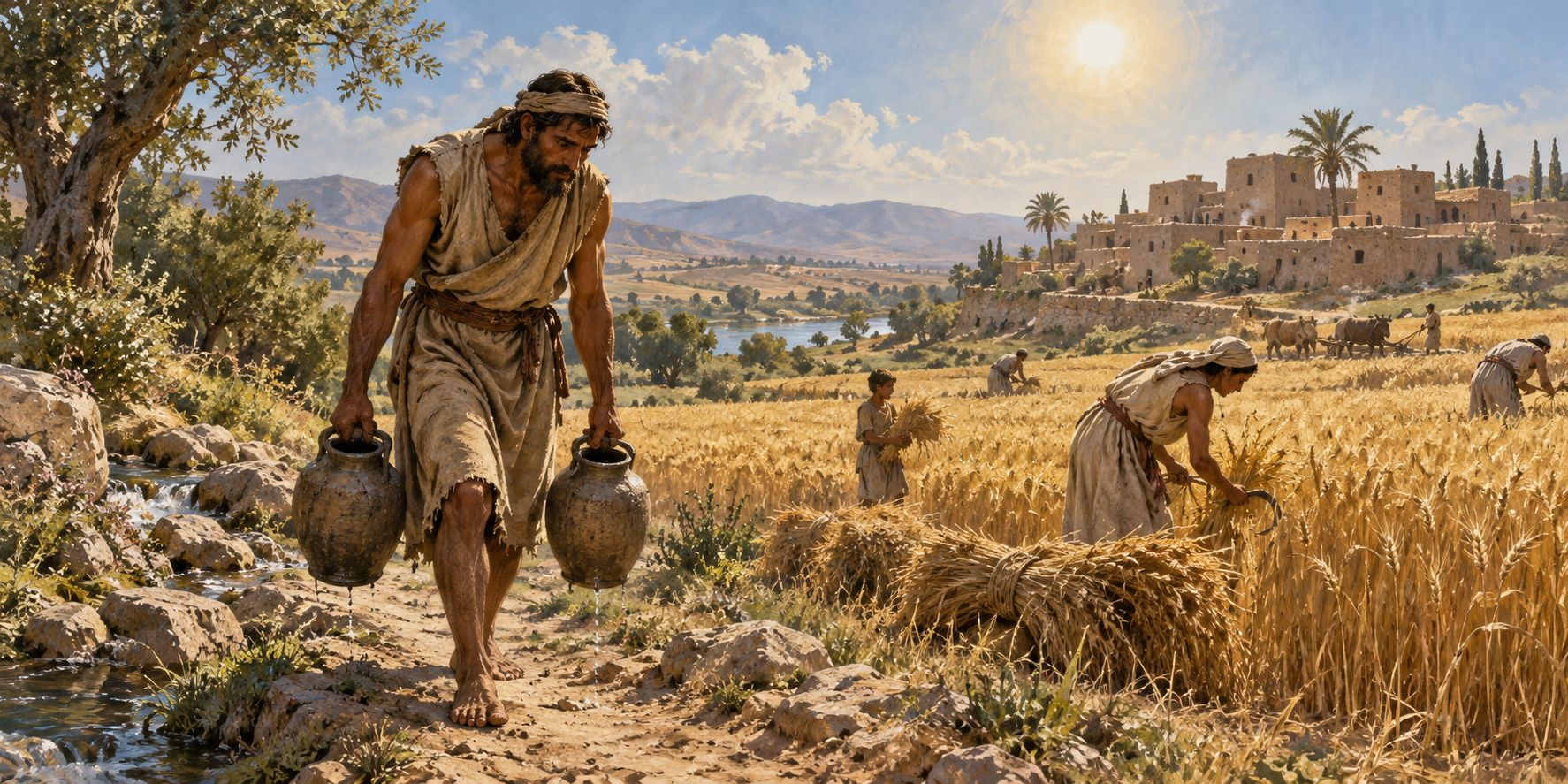
Imagine an early farmer deciding to carry water from the river to a wheat field. The extra work promises a larger harvest, greater security, and children who will not go hungry.
The first part works: more labor produces more grain. But the promised improvement in life runs into consequences the farmer did not anticipate.
- More food supports more people. As the population grows, the larger harvest must feed more mouths. Each person does not necessarily receive a larger share.
- Village life brings new health problems. Harari connects crowded settlements and changes in children’s diets with greater vulnerability to disease.
- Dependence creates risk. A community relying heavily on wheat has fewer alternatives when that crop fails.
- Stored wealth needs defending. Full granaries attract raiders. Protecting the harvest adds walls, guard duties, and fighting to the workload.
The extra effort is real. The easier life remains out of reach.
Why not go back?
Because the change took generations, there was no single moment when everyone could compare the old life with the new one. People remembered smaller harvests in their grandparents’ time, but not necessarily a distant life of hunting and gathering.
Population growth also made retreat difficult. Harari gives a simple example: suppose a village once supported 100 people, but now has 150. Returning to the old level of production would leave 50 people without enough food.
Nobody volunteers to be among those who go hungry. The villagers keep watering the fields because the community now depends on the extra work.
What began as an improvement has become an obligation.
When luxuries become necessities
Harari calls this the luxury trap: people get used to an improvement, build their lives around it, and eventually find it difficult to live without it.
His modern example is a student who dreams of becoming a musician. Instead, the student chooses a better-paying career, intending to work hard for a few years, save money, and then pursue music.
Years later, the money has arrived—but so have a mortgage, family responsibilities, and expensive habits. Leaving the job is no longer as simple as it once appeared.
The plan was to buy freedom later. The result was a life with more commitments.
Saving time can create more work
Email illustrates the same problem in a different way.
Compared with writing and posting a letter, sending an email takes almost no time. Yet that convenience changes how much people communicate and how quickly they expect an answer.
A few letters become dozens of messages. Waiting patiently for a reply becomes expecting one today. The work required for each message falls, but the total volume of communication rises.
Harari’s point is that making an activity more efficient does not automatically make life more relaxed. Our expectations can expand to consume the time we save.
Not everyone had to choose farming
Some groups continued hunting and gathering. But, in Harari’s account, farming could spread without persuading every neighboring group that it offered a better life.
Agricultural communities could support larger populations. As those populations expanded, neighboring foragers faced pressure to move elsewhere or adopt farming themselves.
The spread of agriculture therefore does not, by itself, prove that individual farmers were healthier or happier. A way of life can expand because it sustains more people, even when it demands more from each person.
Another possibility: belief before comfort
The lecture also considers a different explanation. Perhaps some people accepted harder work to fulfill a shared cultural or religious ambition.
Harari discusses Göbekli Tepe in southeastern Turkey, with its monumental stone pillars and animal carvings. In the interpretation he presents, communities of hunter-gatherers undertook substantial building projects that required cooperation and a common purpose.
Could feeding the people who built and gathered at such a center have encouraged more intensive cultivation?
That possibility reverses the familiar sequence. Instead of farming producing prosperous villages that later built temples, a shared ceremonial project might have helped create the need for farming and permanent settlement.
Harari presents this as a hypothesis, not a settled explanation. The site’s purpose and its relationship to early agriculture remain questions in the lecture. Even if cultural ambitions helped drive farming there, that would not explain its independent development in every other region.
The question behind the lecture
The “fraud” in Harari’s account need not involve anyone deliberately deceiving anyone else. People can make reasonable choices whose combined consequences create a life none of them intended.
A larger harvest, a higher income, or a faster message may solve an immediate problem while creating new dependencies. The question is not only what an improvement gives us, but what it will require from us once we rely on it.
Next segment: the animals drawn into the agricultural revolution, and what this transformation meant for them.