Notes and reflections on segment 6-3 of Yuval Noah Harari’s course lecture, “Building Pyramids.” This article summarizes his arguments, historical examples, and closing speculation.
Building Pyramids: Why Societies Needed Writing
A kingdom may have full granaries and a population that accepts its laws. Someone still has to know how much grain has arrived, who delivered it, and how much can be distributed.
In the first Building Pyramids article, Harari argued that food alone could not hold a large society together. People also needed shared beliefs. The next article explored how those beliefs become rooted in everyday life.
This segment adds another requirement: ways to store and process information beyond what people can reliably keep in their heads.
Harari approaches the history of writing through that practical problem. Before turning to books and literature, he asks us to think about accounts.
When Memory Becomes a Bottleneck
Living by hunting and gathering required a great deal of knowledge. A person might need to recognize plants, anticipate animal behavior, navigate a landscape, and remember complicated relationships within a community.
Harari contrasts those demands with the administrative work of a city or kingdom. An official collecting taxes needs records of possessions, payments, debts, fines, and exemptions. As the population grows, so does the number of details that must remain available and accurate.
Knowing the people in a small community is one thing. Keeping track of thousands of households and their obligations over many years is another.
Harari explains the difference in evolutionary terms: human memory developed under conditions very different from those of a tax office. That is his broad interpretation of the problem, rather than a claim that foragers could not count or that humans cannot learn mathematics.
The difficulty is maintaining a large, dependable body of numerical information. A ruler’s authority cannot supply a missing account of what has been collected or what remains owed.
Putting Information into Clay
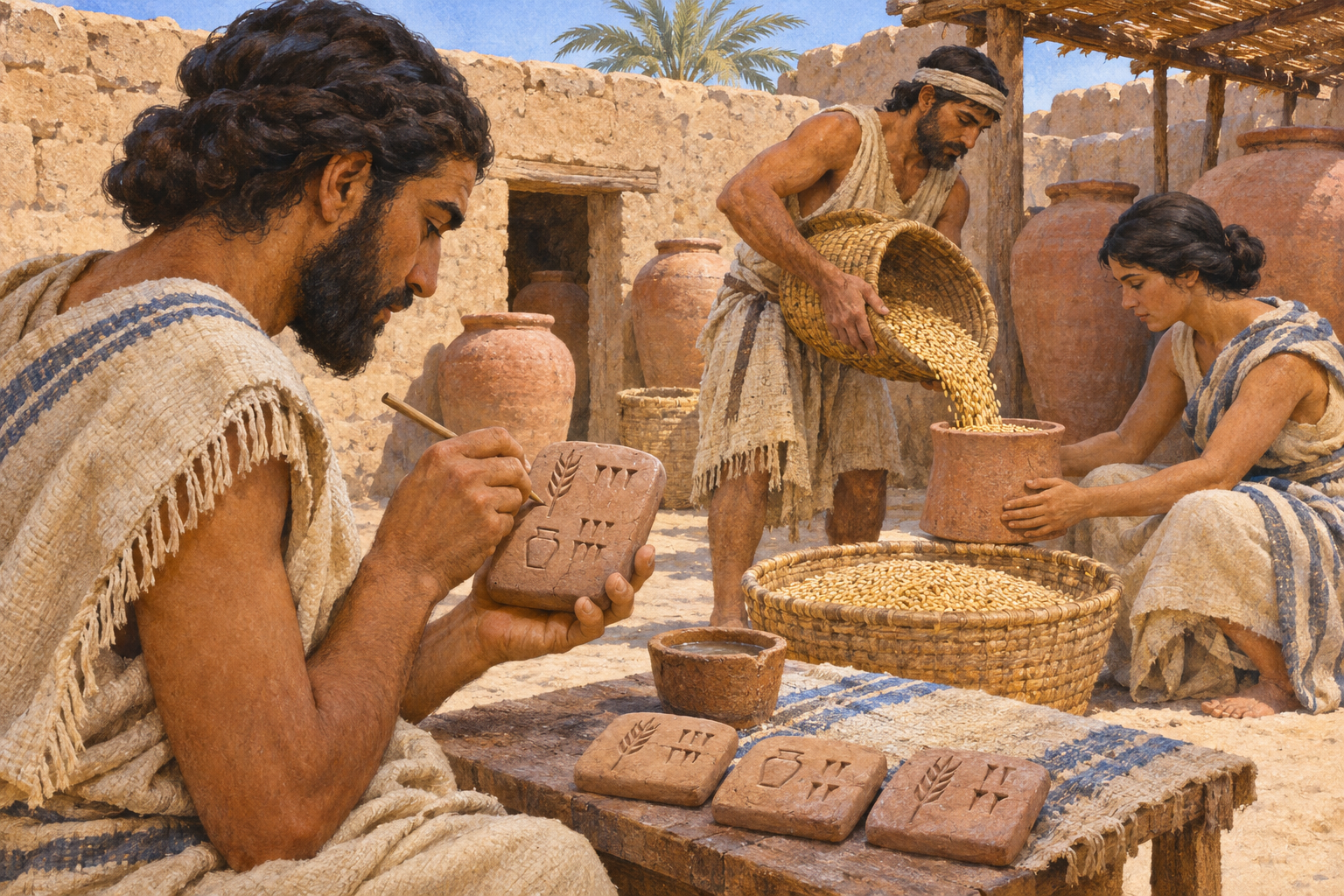
Harari locates a crucial development in southern Mesopotamia, in what is now Iraq. He describes early writing, emerging in the late fourth millennium BC, as a way to keep information outside the human brain.
A mark on clay could preserve a quantity after the person who counted it had forgotten it. Records could be consulted, compared, and used in later calculations. An administration could therefore work with more information than any one participant could memorize.
The connection between early writing and accounting is visible in surviving objects. The Metropolitan Museum of Art’s account of the origins of writing describes early administrative tablets recording goods and rations. It also notes that the origins and spread of writing remain subjects of scholarly debate.
Harari’s emphasis is on the administrative use of this development. People could already tell stories, compose poetry, and discuss the world orally. Keeping extensive accounts presented a different challenge.
Writing eventually served literature, law, religion, and many other purposes. In this part of the lecture, however, the humble economic record takes center stage.
The Uncertainty Behind Kushim
To make the point memorable, Harari discusses an early tablet from Uruk that records barley quantities over a period of months. He draws attention to signs read as Kushim.
The interpretation matters. As Harari acknowledges, Kushim might have been a person’s name, or it might have designated an office or title. If it was a personal name, he suggests, it could be among the earliest names preserved in writing.
That uncertainty should stay with the story. The tablet does not give us a secure biography of a first named accountant.
What interests Harari is the possibility that someone remembered through an ordinary administrative task has survived in the historical record. When we imagine the beginnings of writing, we may picture a great poem or a king announcing a victory. His example directs our attention to a grain account instead.
Why Institutions Speak in Numbers
Harari then carries the argument into modern life.
Governments, companies, and other organizations depend on numerical records. Budgets, inventories, payments, and statistics make it possible to coordinate activities across distances and among people who will never meet.
He argues that this gives numbers a special influence over institutional decisions. Information that can be counted and compared is easier for an organization to circulate and use.
His further warning is that experiences which resist numerical expression may receive less attention. That is a criticism of how institutions assign importance, rather than a literal rule that everything unmeasured disappears.
The question raised by his argument is worth keeping in mind: when an organization counts some things carefully, what does it leave out?
Thinking with Tools
Writing also changes what people can work out, not just what they can remember.
Harari uses physics as an example. Complex mathematical work relies on equations written on paper or blackboards and calculations performed with computers. These tools let people follow relationships and carry out operations that would be difficult to hold entirely in memory.
On this view, part of the work of thinking happens through interaction with an external record. A written calculation preserves intermediate steps so that someone can inspect them and continue.
The same general principle connects a clay account with a much later mathematical calculation: people expand their abilities by giving information a durable form outside their heads.
From Clay Tablets to Binary Code
Near the end of the segment, Harari turns to binary encoding, in which computers represent information using zeros and ones. Even the recorded words of the lecture reach its audience through digital systems.
He closes with a speculative possibility: could systems developed to assist human thought eventually support an intelligence that replaces it? The lecture presents this conditionally. It is a question about a possible future, rather than an established conclusion from the history of writing.
The historical argument is more immediate. In Harari’s account, agricultural societies grew through a combination of food production, shared orders, and techniques for managing information. Belief could establish an obligation; records helped an administration keep track of it.
That combination made larger systems of cooperation possible. It also leads into the next lecture’s question: how did some groups gain advantages within those systems while others were marginalized or exploited?
Previous: Building Pyramids: How Imagined Orders Become Everyday Life